Projects — what works, applied.
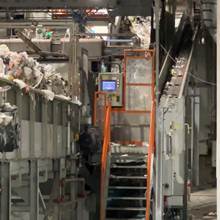
Accelerating plastic recycling through behavioural science and AI.
Plastic packaging remains one of the greatest challenges in the transition towards a true circular economy. Despite well-developed collection systems, only a fraction of household plastic packaging is recycled, largely due to a lack of knowledge and behavioural barriers, rather than technical limitations.
MOWW addresses this challenge by combining behavioural science, artificial intelligence, and agent-based modelling to identify, predict, and influence the behaviours that drive recycling outcomes. The objective is not only to increase recycling rates but also to reduce overall plastic consumption by joyfully creating lasting behavioural change within communities.
MOWW — a platform to significantly increase the collection of household plastic packaging in Sweden. By combining AI-based values analysis, Organisational Behaviour Management (OBM), and agent-based modelling (ABM), we identify what actually drives household sorting behavior and do More Of What Works. Our goal is to help municipalities reach a significantly higher collection rate.
Six barriers keep plastic out of the loop.
Traditional information campaigns often produce limited and short-lived effects because they fail to address the underlying drivers of behaviour.
What happens after you sort — step by step.
How plastic is sorted at Svensk Plaståtervinning after collection:
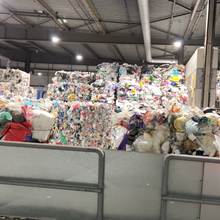
Baled mixed plastic is fed into the shredder.
The shredder breaks apart the bales.
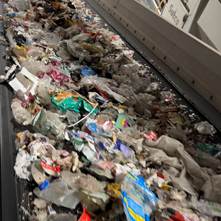
The unsorted plastic is conveyed to the sorting line.
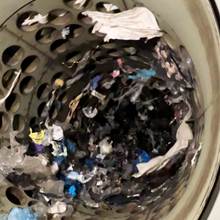
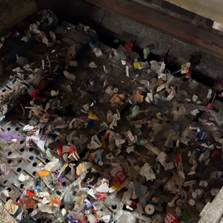
A rotating drum mechanically performs the initial coarse sorting, separating the plastic by size through perforations of different diameters.
The plastic is then further sorted using additional perforated screens for finer size separation.
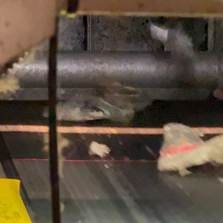
The plastic packaging is scanned using laser-based sensor technology to identify the polymer type.
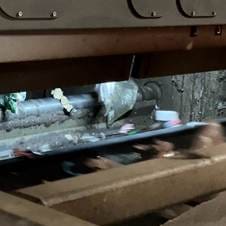
As each item reaches the end of the conveyor belt, precisely timed air jets separate the targeted plastic fraction by blowing it over a barrier into the designated collection stream.
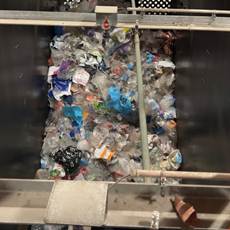
The sorted plastic is collected in different containers.
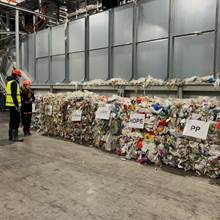
The various plastic types can now be baled once again and transported for washing and pellet production.
The purpose of presenting the plastic sorting process is to challenge the widespread misconception that plastic collected for recycling is not actually recovered. Today, all household plastic packaging deposited at recycling stations undergoes advanced sorting. The greatest barrier to increasing recycling rates is that a significant proportion of household plastic is never returned to the recycling system by consumers.
Looking beyond plastic.
Plastic recycling is only the first application for MOWW. The same platform can be adapted to address a wide range of sustainability challenges, including food waste, metal packaging, sustainable mobility, sustainable consumption and other areas where lasting behavioural change is essential.
Food waste
Mandatory household food waste sorting has been in force in Sweden since January 2024, yet compliance varies widely between households and municipalities. As the bottleneck is purely behavioural — not technical or infrastructural — this is a natural next application for the MOWW model, using the same values-based communication approach already validated for plastic packaging.
Metal packaging
Metal packaging (aluminium and steel) is infinitely recyclable without loss of quality and holds high material value, yet a significant share still ends up in household waste through habit rather than lack of knowledge. With a short, well-defined “sorting journey” for households, it offers a clear and easily measurable next step for the MOWW model.